
Learning Spanish doesn’t have to begin with complicated grammar, verb conjugations, or hundreds of vocabulary words.
For beginners, everyday Spanish conversations are usually:
- Short
- Repetitive
- Situation-based
- Built around a few useful phrases
That’s good news.
You don’t need to speak perfect Spanish to start communicating.
Your first goal is much simpler:
Say enough Spanish to connect, ask for help, and handle everyday situations confidently.
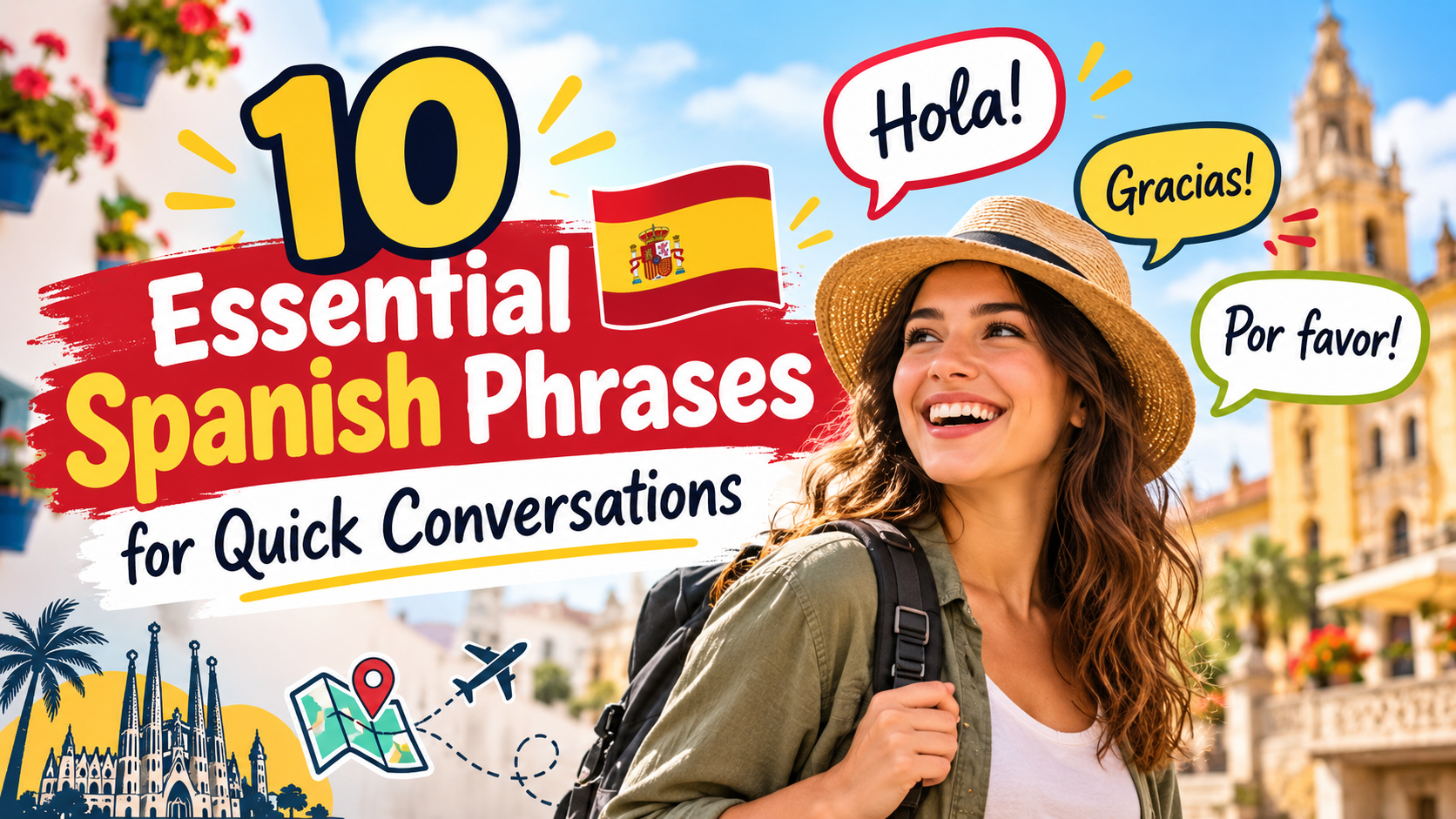
Here are 10 Spanish phrases you can start using immediately.
1. Start Every Conversation with “Hola”
Key spoken phrase
Hola
(OH-lah)
“Hello”
This is one of the easiest and most useful Spanish words you’ll ever learn.
Use it when:
- Entering a store
- Meeting someone
- Talking to hotel staff
- Starting a conversation
- Greeting a neighbor
You don’t need a complicated introduction.
Sometimes one friendly Hola is enough to open the conversation.
Quick conversation:
You: Hola.
Other person: Hola.
That’s already Spanish communication.
2. Say “Gracias” Often
Essential phrase
Gracias
(GRAH-see-ahs)
“Thank you”
A little gratitude goes a long way in any language.
For extra appreciation, say:
Muchas gracias
(MOO-chahs GRAH-see-ahs)
“Thank you very much.”
You can use Gracias after someone:
- Gives you directions
- Brings your food
- Helps you in a store
- Answers your question
- Opens a door
- Helps you at a hotel
Don’t wait until your Spanish is perfect.
A smile and Gracias already communicate a lot.
3. Make Requests with “Por Favor”
Useful phrase
Por favor
(por fah-VOR)
“Please”
This is one of the easiest ways to make your Spanish sound polite.
You can combine it with many simple requests.
For example:
Agua, por favor.
“Water, please.”
La cuenta, por favor.
“The check, please.”
Even when you don’t know the full sentence, adding por favor can make a simple request work.
Simple Spanish + politeness beats complicated Spanish you’re afraid to speak.
4. Shopping: Ask “¿Cuánto Cuesta?”
Shopping is one of the easiest places to practice beginner Spanish because the conversation is predictable.
Essential shopping phrase
¿Cuánto cuesta?
(KWAN-toh KWEH-stah?)
“How much does it cost?”
Point to an item and ask:
¿Cuánto cuesta?
That may be all you need.
Quick conversation
You: ¿Cuánto cuesta?
Seller: Diez euros.
You: Gracias.
Three simple phrases can create a complete real-world interaction.
You don’t need perfect grammar—you need a question that works.
5. Finding the Bathroom: “¿Dónde Está el Baño?”
Some phrases are useful.
Others are urgently useful.
Essential travel phrase
¿Dónde está el baño?
(DON-deh eh-STAH el BAH-nyoh?)
“Where is the bathroom?”
This phrase is useful in:
- Restaurants
- Airports
- Hotels
- Train stations
- Museums
- Shopping centers
If you remember only a few Spanish travel phrases, this should probably be one of them.
Helpful pattern
Notice:
¿Dónde está…?
“Where is…?”
Once you know this pattern, you can ask about many places.
¿Dónde está el hotel?
“Where is the hotel?”
¿Dónde está la estación?
“Where is the station?”
One useful phrase can unlock many conversations.
6. When Something Goes Wrong: “Lo Siento”
Mistakes happen when you travel and when you learn a language.
That’s normal.
Useful phrase
Lo siento
(loh see-EN-toh)
“I’m sorry.”
Use it if you:
- Bump into someone
- Make a mistake
- Misunderstand someone
- Need to apologize
You don’t need a long explanation.
Often, Lo siento is enough.
Learning how to recover from awkward moments is just as important as learning how to start conversations.
7. When You Don’t Understand: “No Entiendo”
This may be one of the most important phrases for beginners.
Say this confidently
No entiendo.
(noh en-tee-EN-doh)
“I don’t understand.”
Many beginners freeze when someone responds quickly in Spanish.
Don’t panic.
Simply say:
No entiendo.
This tells the other person that you need help or clarification.
The goal isn’t to understand every word.
The goal is to keep the conversation moving.
Knowing how to say I don’t understand actually gives you more confidence to speak.
8. Ask for English When You Need Help
Sometimes the conversation becomes too complicated.
That’s okay.
Useful phrase
¿Habla inglés?
(AH-blah een-GLEHS?)
“Do you speak English?”
This is especially useful when you need help with something important, such as:
- Transportation
- Hotel reservations
- Medical situations
- Tickets
- Directions
- Complicated purchases
Trying Spanish first—even briefly—is often a great way to begin the interaction.
You can say:
Hola. ¿Habla inglés?
Simple, polite, and effective.
9. Introduce Yourself: “Me Llamo…”
Meeting someone new doesn’t require a long Spanish introduction.
Essential phrase
Me llamo [your name].
(meh YAH-moh…)
“My name is…”
For example:
Me llamo Andrew.
Quick conversation
You: Hola. Me llamo Andrew.
Other person: Hola. Me llamo Carlos.
You: Mucho gusto.
Even if the rest of the conversation happens slowly, you’ve already made a connection.
Start with what you know.
10. Finish with “Adiós”
Essential phrase
Adiós
(ah-dee-OHS)
“Goodbye.”
It’s simple, friendly, and useful every day.
A complete beginner conversation can be surprisingly short:
Hola.
¿Cuánto cuesta?
Gracias.
Adiós.
That’s a real conversation.
And that is exactly the point.
You don’t need hundreds of vocabulary words before you start speaking.
What a Beginner Spanish Conversation Actually Looks Like
Beginners sometimes imagine that speaking Spanish requires long sentences.
Usually, it doesn’t.
Imagine you’re shopping:
You: Hola.
Seller: Hola.
You: ¿Cuánto cuesta?
Seller: Quince dólares.
You: Gracias.
Seller: De nada.
You: Adiós.
You may know only a handful of Spanish phrases, but you successfully communicated.
That’s progress.
When You Get Stuck, Use Your Survival Phrases
A beginner conversation might go like this:
You: Hola.
Other person: ¡Hola! ¿Cómo estás? ¿De dónde vienes? ¿Estás visitando la ciudad?
You suddenly understand almost nothing.
No problem.
Say:
No entiendo.
If necessary:
¿Habla inglés?
The conversation can continue.
Learning Spanish isn’t about never getting stuck.
It’s about knowing what to say when you do.
Your 10 Spanish Survival Phrases
Here are all ten together:
- Hola — Hello
- Gracias — Thank you
- Por favor — Please
- ¿Cuánto cuesta? — How much does it cost?
- ¿Dónde está el baño? — Where is the bathroom?
- Lo siento — I’m sorry
- No entiendo — I don’t understand
- ¿Habla inglés? — Do you speak English?
- Me llamo [your name] — My name is [your name]
- Adiós — Goodbye
Don’t just memorize them.
Use them as building blocks for conversations.
How to Learn These Quickly — 10–15 Minutes a Day
Instead of studying the list silently, practice these phrases as spoken language.
Minutes 1–5: Read Out Loud
Say every phrase aloud several times.
Don’t worry about sounding perfect.
Your mouth needs practice producing Spanish—not just your brain recognizing it.
Minutes 6–10: Listen and Repeat
Listen to the phrase spoken naturally and repeat it immediately.
Try to copy:
- Rhythm
- Stress
- Speed
- Intonation
Don’t obsess over individual sounds.
Practice the whole phrase.
Minutes 11–15: Role-Play Real Situations
Imagine yourself actually using Spanish.
You’re entering a café:
Hola.
You’re ordering:
Por favor.
You’re shopping:
¿Cuánto cuesta?
You’re lost:
¿Dónde está el baño?
You don’t understand:
No entiendo.
Someone helps you:
Gracias.
You’re leaving:
Adiós.
Practice situations, not isolated vocabulary.
The Most Important Beginner Spanish Rule
Don’t wait until you “know Spanish” before you speak Spanish.
Speaking is how Spanish starts becoming real.
You don’t need:
500 vocabulary words.
Ten verb tenses.
Perfect pronunciation.
Perfect grammar.
You need a few phrases that work—and the confidence to use them.
Start with these ten.
Say them aloud.
Use them whenever you can.
Then slowly add new phrases around them.
Soon Spanish will feel less like something you’re studying and more like something you’re actually using.
Start small. Speak often. Build confidence.
A journey of a thousand palabras can begin with one simple word:
Hola.