
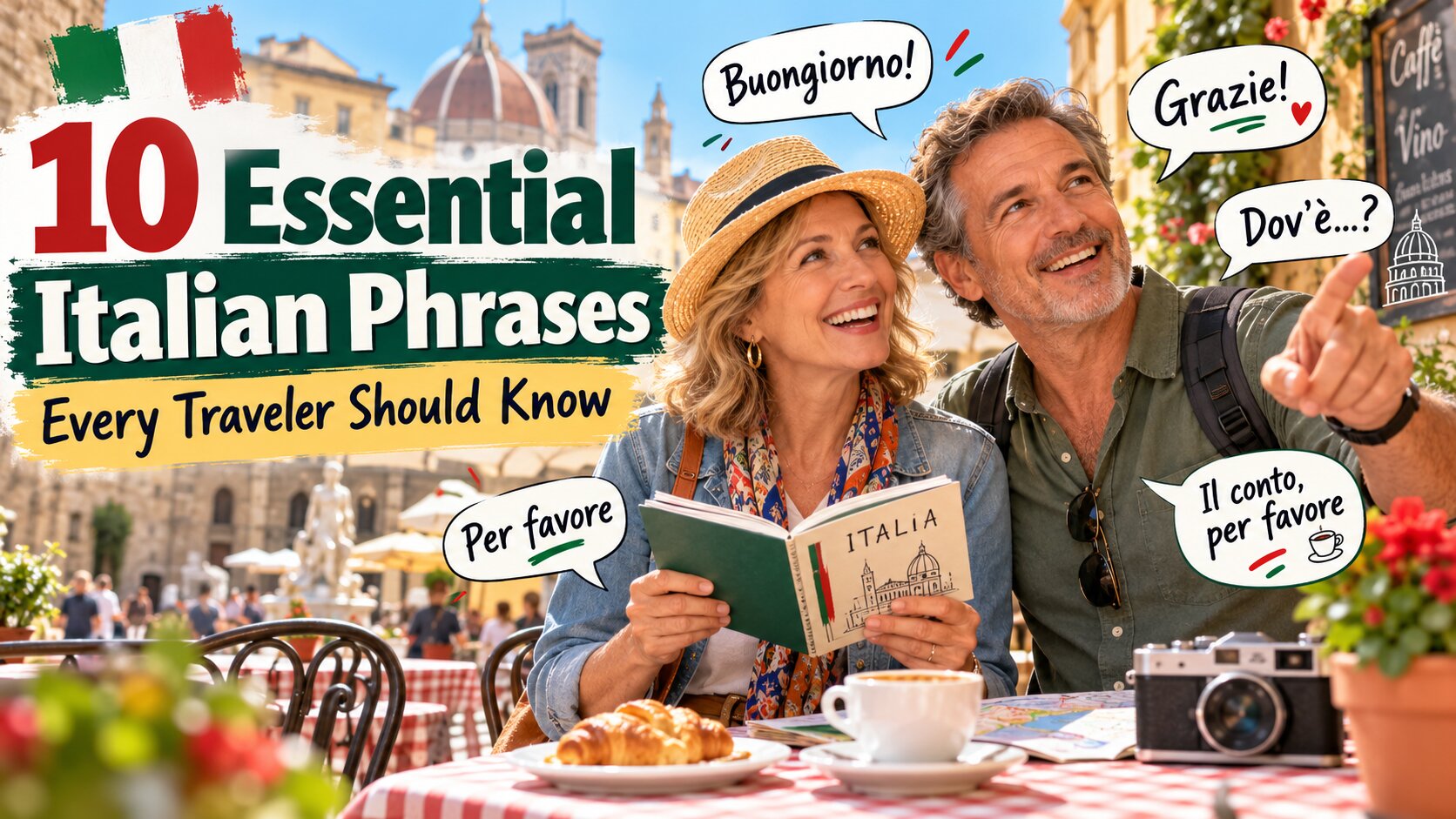
You do not need to speak fluent Italian to enjoy Italy.
In fact, learning just a few useful phrases can make ordering food, asking for directions, checking into a hotel, and meeting local people much easier.
The goal is not perfect grammar. The goal is simple communication.
Here are 10 essential Italian phrases every traveler should know before visiting Italy.
1. Buongiorno — Good morning / Good day
Italian: Buongiorno
Pronunciation: bwohn-JOR-noh
Meaning: Good morning / Good day
This is one of the most useful greetings in Italy.
Use it when entering a café, hotel, restaurant, shop, or when speaking to someone during the daytime.
Example:
Buongiorno! Un caffè, per favore.
Good morning! A coffee, please.
2. Grazie — Thank you
Italian: Grazie
Pronunciation: GRAHT-see-eh
Meaning: Thank you
A simple “grazie” goes a long way.
You will probably use this phrase dozens of times during your trip.
Example:
Grazie mille!
Thank you very much!
3. Per favore — Please
Italian: Per favore
Pronunciation: pehr fah-VOH-reh
Meaning: Please
Add “per favore” when ordering food, asking for help, or requesting something politely.
Example:
Un’acqua, per favore.
A water, please.
4. Mi scusi — Excuse me
Italian: Mi scusi
Pronunciation: mee SKOO-zee
Meaning: Excuse me
Use this when approaching someone, asking a question, getting someone’s attention, or politely moving through a crowd.
Example:
Mi scusi, dov’è la stazione?
Excuse me, where is the station?
5. Dov’è…? — Where is…?
Italian: Dov’è…?
Pronunciation: doh-VEH
Meaning: Where is…?
This phrase is extremely useful when exploring a new city.
Simply add the place you are looking for.
Examples:
Dov’è il bagno?
Where is the bathroom?
Dov’è la stazione?
Where is the train station?
Dov’è il mio hotel?
Where is my hotel?
6. Quanto costa? — How much does it cost?
Italian: Quanto costa?
Pronunciation: KWAHN-toh KOH-stah
Meaning: How much does it cost?
Perfect for markets, souvenir shops, cafés, and stores.
Example:
Quanto costa questo?
How much does this cost?
Even if the answer comes back quickly in Italian, recognizing the question can make shopping much easier.
7. Vorrei… — I would like…
Italian: Vorrei…
Pronunciation: vor-RAY
Meaning: I would like…
This may be the single most useful phrase when ordering food and drinks.
Instead of memorizing complicated sentences, simply say:
Vorrei + what you want.
Examples:
Vorrei una pizza.
I would like a pizza.
Vorrei un cappuccino.
I would like a cappuccino.
Vorrei due biglietti.
I would like two tickets.
8. Il conto, per favore — The check, please
Italian: Il conto, per favore
Pronunciation: eel KON-toh pehr fah-VOH-reh
Meaning: The check, please
Unlike in some countries, restaurant staff in Italy may not automatically bring your bill immediately after you finish eating.
When you are ready to leave, simply say:
Il conto, per favore.
It is one of the most useful restaurant phrases to memorize.
9. Parla inglese? — Do you speak English?
Italian: Parla inglese?
Pronunciation: PAR-lah een-GLAY-zeh
Meaning: Do you speak English?
When your Italian reaches its limit, this phrase can help.
Starting with a few words of Italian before switching to English is also a polite gesture.
You can say:
Mi scusi, parla inglese?
Excuse me, do you speak English?
10. Non capisco — I don’t understand
Italian: Non capisco
Pronunciation: non kah-PEE-skoh
Meaning: I don’t understand
Sometimes someone will answer your Italian question with a full-speed Italian response.
That is when this phrase becomes very useful.
Non capisco.
You can also add:
Può parlare più lentamente?
Can you speak more slowly?
Bonus Phrase: Ciao!
Italian: Ciao
Pronunciation: chow
Meaning: Hi / Bye
“Ciao” is probably the most famous Italian word in the world.
It is commonly used with friends and in casual situations.
For more formal situations, especially when greeting strangers, buongiorno is often the safer choice.
The Secret: Learn Phrases, Not Hundreds of Words
Many travelers think they need to memorize hundreds of Italian vocabulary words before visiting Italy.
You don’t.
A better strategy is to memorize a small collection of phrases that solve common travel situations.
For example:
Vorrei… helps you order.
Dov’è…? helps you find places.
Quanto costa? helps you shop.
Mi scusi helps you start conversations.
With only a handful of sentence patterns, you can communicate far more than you might expect.
Your 10-Phrase Italian Travel Cheat Sheet
- Buongiorno — Good morning / Good day
- Grazie — Thank you
- Per favore — Please
- Mi scusi — Excuse me
- Dov’è…? — Where is…?
- Quanto costa? — How much does it cost?
- Vorrei… — I would like…
- Il conto, per favore — The check, please
- Parla inglese? — Do you speak English?
- Non capisco — I don’t understand
You do not need perfect Italian to have meaningful interactions in Italy.
Start with these ten phrases, practice saying them aloud, and use them whenever you get the chance.
A few confident words of Italian can turn a simple trip into a much more personal experience.